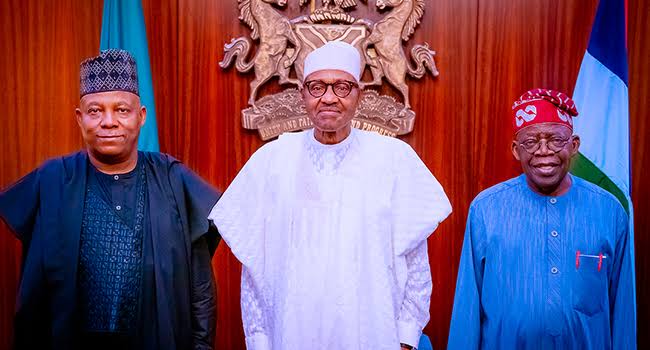
Vice President Kashim Shettima has offered a window into President Bola Tinubu’s temperament and it centres on the late Muhammadu Buhari.
Speaking at the Niger Delta Agricultural Development and Investment Summit, Shettima said Tinubu doesn’t reach for the blame game, and that over the past three years, criticism of his predecessor has been the surest way to provoke him. In Shettima’s telling, Tinubu accepts that responsibility ends at his own desk regardless of what he inherited.
He also cast the president as someone willing to confront the country’s problems head-on rather than deflect them.
The reaction was split
The remarks landed unevenly online. Critics pointed to what they see as a contradiction: the presidency has repeatedly framed the economy as something Tinubu inherited in poor condition, which sits awkwardly beside a claim that he refuses to blame his predecessor. Some tied that to questions about spending on aircraft and vehicles during a period the government describes as constrained.
Others were more approving, reading the speech as the kind of rallying language a leader should offer and praising Shettima’s delivery.
A third strand sidestepped the rhetoric entirely, arguing that accountability isn’t measured in speeches or defences of predecessors but in cost of living, security, jobs, and economic stability outcomes voters can see for themselves.
Why the framing matters
Shettima’s line is doing quiet political work. Positioning Tinubu as protective of Buhari’s legacy signals continuity to the northern APC base ahead of 2027, a bloc Buhari commanded and whose loyalty is not automatically transferable. At the same time, the “buck stops here” framing pre-empts the criticism that this administration leans on inherited problems. Whether both messages can hold at once is exactly what the pushback is testing.